
Teacher Sorted · 9 September 2026 · 11 min read
Why your teacher to-do list never gets finished : and why that's not the real problem
Your list looks the same at 5.10pm as it did at 7.30am. Again. How can you fix this common teacher problem?
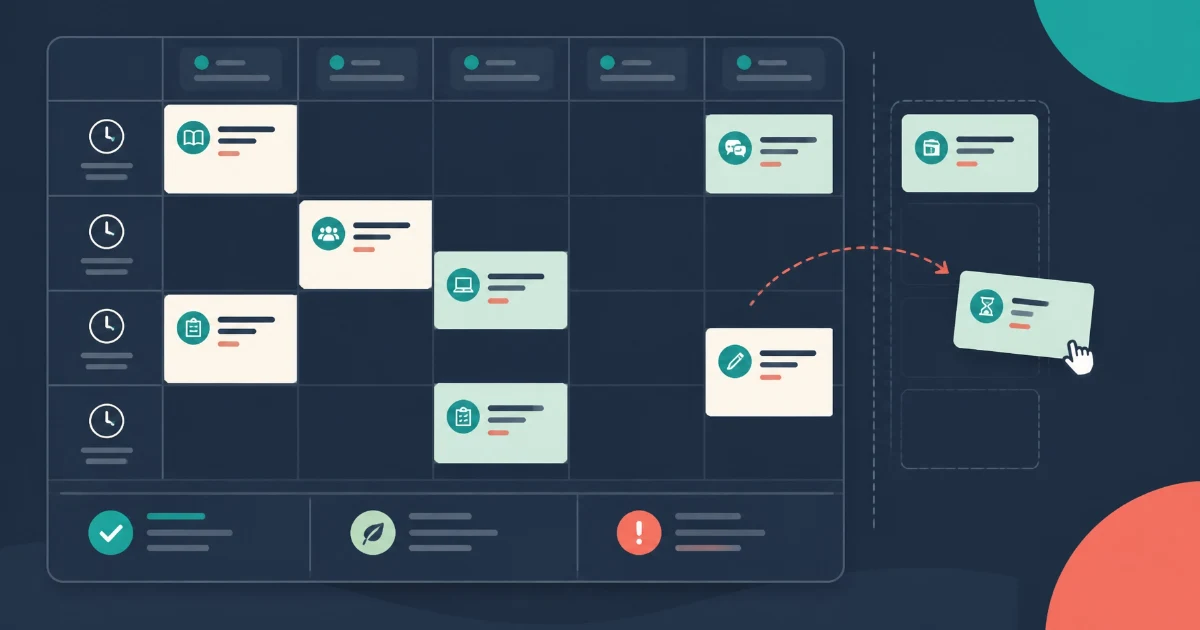
There is a particular kind of frustration in looking at your list at 5.10pm and realising it is basically the same list you had at 7.30 that morning.
You have done things. You have taught all day. You may have dealt with a behaviour issue before registration, covered someone else’s class for twenty minutes, lost half your PPA to a meeting that "will only take ten minutes", and spent lunch talking to a child who was clearly not ready to go back outside yet.
But the list is still there.
Marking is still there.
Planning is still there.
The email you meant to answer is still there.
Then someone mentions the trip letter. A parent catches you at the door. The meeting after school produces three more actions and at least one of them somehow belongs to you.
By Friday, the list can start to feel less like a tool and more like a record of what you did not get to.
That is not because you have failed to organise yourself. It is because the list is only showing half the picture.
A to-do list does not show the real problem
Most to-do lists answer one question:
What needs doing?
That matters. In schools, if you do not catch the job when it appears, it often disappears until the worst possible moment.
But the list often misses the harder question:
When is this actually meant to happen?
A list of tasks sitting apart from your timetable makes everything look equally doable. You can keep adding marking, planning, data entry, displays, phone calls, intervention notes and resources for next week, and the list just gets longer.
Time does not behave so politely.
You might have 45 minutes of PPA on Tuesday, unless it gets swallowed by cover. You might have an hour after school on Wednesday, unless the parent conversation you needed to have takes the whole thing. You might have planned to use Friday afternoon for assessment, only to find that a child in your class needs far more of you than the timetable had in mind.
The list does not change much.
The time available does.
That is the real problem with a lot of workload advice for teachers. It still assumes the job is to find a cleverer way of getting through the pile.
But teaching does not give you a pile that stays still.
There is always another lesson coming, another set of books, another child who needs support, another admin deadline, another decision that cannot really be made later. You can work hard, work sensibly and still end the week with important things left undone.
That does not mean nothing gets finished. It means "finished" cannot mean "every possible job is done".

Your list may be doing one job well and another job badly
A long teacher to-do list is not necessarily a sign that you are disorganised.
Often it is just trying to do two different jobs.
The first is to help you remember things before they vanish under the day.
A thought turns up while you are on duty, walking pupils to assembly or waiting for the photocopier to jam again:
- Ask about the Year 5 trip
- Print the science sheets
- Mark spelling books
- Email Sam’s parent
- Sort the cupboard before inspection
- Check the assessment dates
Writing those down helps. Otherwise you spend the next lesson trying to teach while also repeating "trip letter, trip letter, trip letter" in the back of your mind.
The second job is harder. It is deciding what can actually be done with the time you have got.
That needs more than a list. How long will it take? When is it needed? What else is competing for the same bit of time? What happens if it waits? Does it even need doing in the form you first imagined?
A capture list can hold everything.
A workable plan cannot.
That matters, because the full list is not a promise to yourself that all of it will be done today. It is a place to keep things so your head does not have to. The decisions come later, when you look at the week properly.
The useful question is what fits
When there is more work than time, the job is not to somehow squeeze it all in.
The job is to decide what fits.
That sounds obvious, but it is not how most of us were taught to think about workload. In schools, there is a strong habit of writing everything down, carrying all of it, and hoping a decent chunk of it will get cleared if you are organised enough.
Usually, the problem is not organisation. It is mismatch.
There is more work than there are hours.
So before you plan the work, look at the time.
1. Look at the time first
Write down the non-teaching time you genuinely have.
Include:
- PPA
- Preparation periods
- Time before school
- Time after school
- A specific evening, if you have chosen to work then
- Any other time you can actually rely on
Do not count every little gap in the day. A ten-minute slot between lessons is often not really a slot at all. It disappears into photocopying, resetting the room, finding a TA, dealing with a message from the office, or talking to a child who has had a wobble and is in no state to line up cheerfully for the next lesson.
Do not count time you do not intend to give to work. If Tuesday evening is for your own children, or football, or just being a person for a bit, it is not available work time.
That is not laziness. It is just true.
The point is not to produce a perfect audit of every minute. It is to see the actual shape of the week before you start pretending it has more room than it does.
2. Give tasks a rough size
You do not need perfect estimates.
But "mark books" is not much use as a planning unit. It might be 20 minutes. It might swallow the whole evening, especially if the books come back quicker than you can mark them and half the class have all made the same mistake in different handwriting.
Something like "mark 30 maths books, about two minutes each" is more useful.
The estimate may be wrong. Fine. Teaching is full of jobs that expand the moment you touch them.
Use ordinary descriptions:
- Plan Monday’s maths lesson : 40 minutes
- Reply to trip email : 10 minutes
- Mark Year 6 writing : 90 minutes
- Prepare resources for fractions : 30 minutes
- Call parent about reading : 15 minutes
A rough size is still better than leaving every task as a vague fog of work.
3. Put in less than the full amount
If you have two hours of PPA, do not plan two solid hours of work into it.
Schools are not tidy enough for that.
Someone will knock on the door. The photocopier will have a moment. A child will need finding. A colleague will ask if you have got two minutes. You will open your inbox looking for one email and lose seven minutes to something else entirely.
Leave some room.
If you have an hour, plan 40 or 45 minutes of actual task time. That does not mean the rest is wasted. It means the plan has some chance of surviving contact with a normal school day.
This also fits the practical advice to look at real calendar time rather than simply listing responsibilities. As Edutopia explains, a planning routine works better when it takes account of the time you really have, including time already taken by other responsibilities.
4. Choose what matters now
Once you can see the time, choose the work that belongs in it.
Consider:
- What has a genuine deadline?
- What affects tomorrow’s teaching?
- What has consequences for pupils or colleagues if it waits?
- What will take longer if you leave it?
- What can be reduced, postponed, delegated or dropped?
- What are you still waiting on before you can do it properly?
This is not a demand to become brilliantly decisive about everything.
Some weeks there is no neat answer. Two important jobs both need doing and there is only time for one. You may need to ask for a deadline to move. You may need to do a stripped-back version. You may need to say, plainly, that there is not enough time for all of it this week.
That is not poor organisation.
That is the work-versus-time problem in its real form.

When everything feels important
One reason teacher workload is so draining is that a lot of the jobs do matter.
Marking matters.
Planning matters.
Contacting a parent matters.
Assessment data matters.
So does the child who stays behind because something is not right.
So does getting home before the whole evening has gone.
The answer is not to pretend only one of those things counts. It is to make the clash visible instead of carrying it around vaguely.
For example:
I have 45 minutes today. I can either mark the books for tomorrow or prepare the resources for Thursday. The books affect tomorrow’s lesson, so I will do those first. I will use Thursday’s PPA for the resources, or ask whether the lesson can run with what we already have.
That is more useful than writing both jobs on a list and hoping some extra time turns up.
A normal to-do list hides the conflict. Both tasks sit there unfinished, and you are left carrying the feeling that you should somehow have done both.
A plan based on time shows the limit. It gives you a reason for doing one now and a place to put the other.
That helps because you stop having to re-make the same decision every time you get an unexpected ten minutes.
Leave work in a state you can return to
There is another problem with unfinished work.
It is not just the task itself. It is also the point you had reached, the decision you had made, the tab you had open, the thing you were going to do next before someone interrupted you.
That is why stopping can feel oddly hard. You are not only leaving work undone. You are trying to hold its place in your head as well.
Before you stop, leave yourself one clear next step:
- Add examples to the introduction
- Print the three-page worksheet
- Finish comments for the last six books
- Check the dates against the trip letter
- Open the shared folder and choose the resources
A short note is enough. You do not need a beautifully organised system for this. You just need to make tomorrow easier for yourself than starting again from "finish planning".
That way, when the next bit of time appears, you can get going without spending the first ten minutes trying to remember what on earth you were doing.

Teacher Sorted is built around that same problem because it is the problem I kept running into in school: not a lack of commitment, and not a lack of lists, but a constant mismatch between the work and the time available to do it. The tool can help if you want something more honest than a standard to-do list, but the principle works perfectly well with a notebook, diary or spreadsheet too. The important bit is keeping the work and the time in view together.
You can see how Teacher Sorted works if you want to explore that approach.
Your list does not need to reach zero
A teacher’s workload is not a queue that eventually disappears.
There will be work left tomorrow. Some of it will still matter. Some of it will turn out not to matter as much as it first seemed. Some of it will need rethinking because the week will change on you, as weeks in school usually do.
That is normal.
A useful plan does not promise that everything will be done. It shows what fits, what waits and what needs an actual conversation rather than private guilt.
So keep the full list if it helps you remember things. But do not expect it to answer the question of what you can realistically do in the next hour.
Start with the time.
Then decide what fits.
That is the job, really: not clearing the list, but making honest decisions in a week that always contains more work than hours.