
Teacher Sorted · 10 September 2026 · 9 min read
What should a teacher actually do in their PPA time?
Learn how to plan PPA blocks realistically, prioritise teaching-related tasks, protect focused time, manage interruptions and replan when available time changes.
PPA time looks generous on a timetable. In practice, it can disappear before you have properly started.
A colleague needs a quick word. The photocopier is jammed. There is an email about a trip that needs answering. Someone asks whether you can cover the last ten minutes of lunch. Then you remember that tomorrow’s science resources are still sitting in a folder somewhere.
By the time you sit down, half the block has gone.
The remaining time often gets spread across eight different jobs. You open the maths planning, check two books, reply to an email, print a worksheet, look at the maths planning again and leave with none of them properly finished.
The useful question is not, “How can I fit more into PPA?”
It is, “What can reasonably move forward in this block?”
That is the starting point for a practical PPA planner.
Start with what PPA is for
PPA stands for planning, preparation and assessment. In England, it is protected time within the school day for work connected to the teaching and learning of the pupils you teach.
The NEU’s guidance on PPA time explains that teachers should receive at least 10% of their timetabled teaching time as PPA, in blocks of at least 30 minutes. It should not be used for cover, duties or meetings.
That matters because PPA is not spare time waiting to be filled with whatever has been left over.
It is one of the few parts of the working day set aside for the work that happens around your lessons:
- Planning the next sequence of learning.
- Preparing resources and materials.
- Marking or assessing pupils’ work.
- Looking at what pupils have understood.
- Deciding what needs to happen next.
- Planning support, challenge or adaptations.
General emails, routine paperwork and every other job on your list may still need doing. They just do not all belong in PPA.
That distinction helps. You cannot complete everything in one block, so you need to choose the work that fits the purpose and the time.
Decide before the block starts
The first few minutes of PPA can easily disappear into deciding what to do.
You look at your list. There is planning, marking, a parent email, a display to finish and a resource to print. Everything appears to be important. You start with the task that feels easiest, then move to another task when it becomes slightly difficult.
A better approach is to make one decision before the block begins.
Write down the main job for the session in ordinary language:
- Plan Monday’s writing lesson.
- Mark the Year 5 fractions work and note the common errors.
- Prepare the science resources for Thursday.
- Adapt the maths activity for the pupils who need more support.
- Finish the next two lessons in the history sequence.
You may have enough time for a small second job. Do not make it the main plan.
If your PPA block is 45 minutes, planning two lessons in detail may be realistic. Planning a whole week, marking a set of books and preparing a display probably is not.
The point is not to guess perfectly. It is to make an honest estimate before the time starts.
Match the job to the length of the block
Different jobs need different amounts of time and attention.
Some work needs a proper stretch of uninterrupted thinking. Some work can be done in ten-minute pieces. Treating them as interchangeable makes PPA harder to use.
Use longer blocks for deep-focus work
A longer block is more suitable for work such as:
- Planning a new unit.
- Sequencing a group of lessons.
- Reviewing assessment information.
- Writing or adapting several lessons.
- Preparing a lesson that needs resources and careful thought.
- Planning support for pupils with additional needs.
These jobs involve decisions. They become slower when you keep stopping and restarting.
If you have 50 minutes, choose one main focus. Put the lesson resources, planning documents and assessment information you need in front of you. Start with the first clear step rather than trying to hold the whole job in your head.
For example:
Read yesterday’s writing. Note the three common problems. Plan tomorrow’s model and independent task.
That is more useful than writing “sort English”.
Use shorter gaps for quick admin
Shorter gaps can still help, but choose work that can be paused without losing your place:
- Print and organise resources.
- Add assessment notes.
- Check the next day’s slides.
- Update a small number of records.
- Send one necessary message.
- Make a list of resources to collect.
- Leave instructions for a teaching assistant.
Be careful with email. It is very good at filling whatever time you give it.
If you open your inbox during a short PPA block, decide what you are checking for. For example, you might look only for information that affects tomorrow’s teaching. You do not need to process every message because it happens to be open.
Protect the first part of the time
PPA is often lost through small interruptions rather than one large event.
Someone asks you to look at a child’s behaviour log. A colleague wants to discuss Friday’s assembly. You remember that you promised to print something. Each interruption may only take a few minutes, but the thinking time between them adds up.
You cannot control every interruption. You can make the first part of the block harder to interrupt.
Try starting with:
- Get the materials you need.
- Put your phone and inbox aside.
- Write the one job you are doing.
- Set a simple stopping point.
- Begin with the next physical action.
The stopping point might be:
Finish the lesson sequence and leave the resources to print.
Or:
Mark 15 books and record the two points to address tomorrow.
A stopping point gives you somewhere to finish. It also makes it easier to return later without reconstructing the whole task.
If your PPA is repeatedly taken for cover, meetings or other duties, that is a staffing and timetable problem rather than a personal planning problem. Keep a record of what is happening and raise it through the appropriate school or union route. The NASUWT guidance on directed time and the NEU guidance on PPA set out the position in England.
Keep a small list of work that fits
A single long to-do list does not tell you what is possible in 30 minutes.
It helps to keep three simple groups instead:
Longer planning jobs
- Plan the next two lessons.
- Review the next unit.
- Look at the latest assessment information.
- Plan adaptations for a particular group.
Medium-sized preparation jobs
- Prepare a set of resources.
- Adapt a worksheet.
- Organise practical equipment.
- Prepare an assessment activity.
- Update the working wall for the next sequence.
Short jobs
- Print tomorrow’s resources.
- Add notes to the assessment record.
- Check the next lesson’s materials.
- Write one message to a colleague.
- Make a list of what needs collecting.
You do not need a complex system. You need a way to see which job suits the time that has appeared.
This is particularly useful in primary schools, where a teacher’s PPA may arrive in several different blocks across the week. A 30-minute block before lunch is not the same as a 90-minute block on Thursday afternoon. Your primary teacher planner needs to reflect that difference.
Leave yourself a way back in
PPA often gets interrupted. A class returns early. A safeguarding issue needs attention. A meeting runs over. The job you started may not be finished.
Before you stop, leave a short note:
- Read pages 12–18. Next: choose two examples for the model.
- Resources are in the shared folder. Next: print the support version.
- Marked books are on the side. Next: group pupils by the common error.
- Planning is drafted. Next: add the independent task.
This takes less than a minute. It saves you from opening the document next time and wondering what you were doing.
Unfinished work is not always badly managed work. Sometimes the available time changed. What matters is whether you can see where to return.
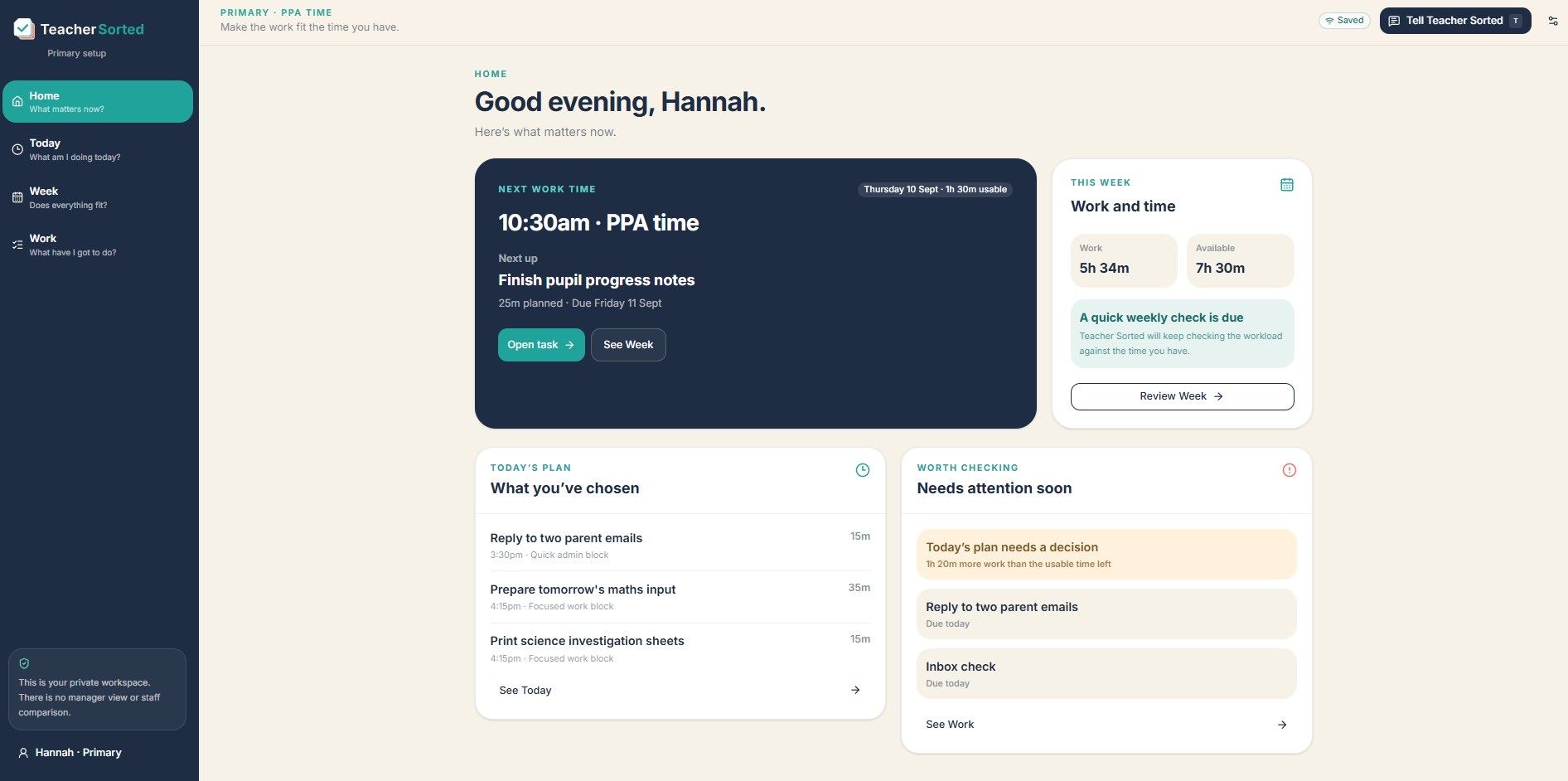
Replan when PPA disappears
There will be days when your planned PPA does not happen.
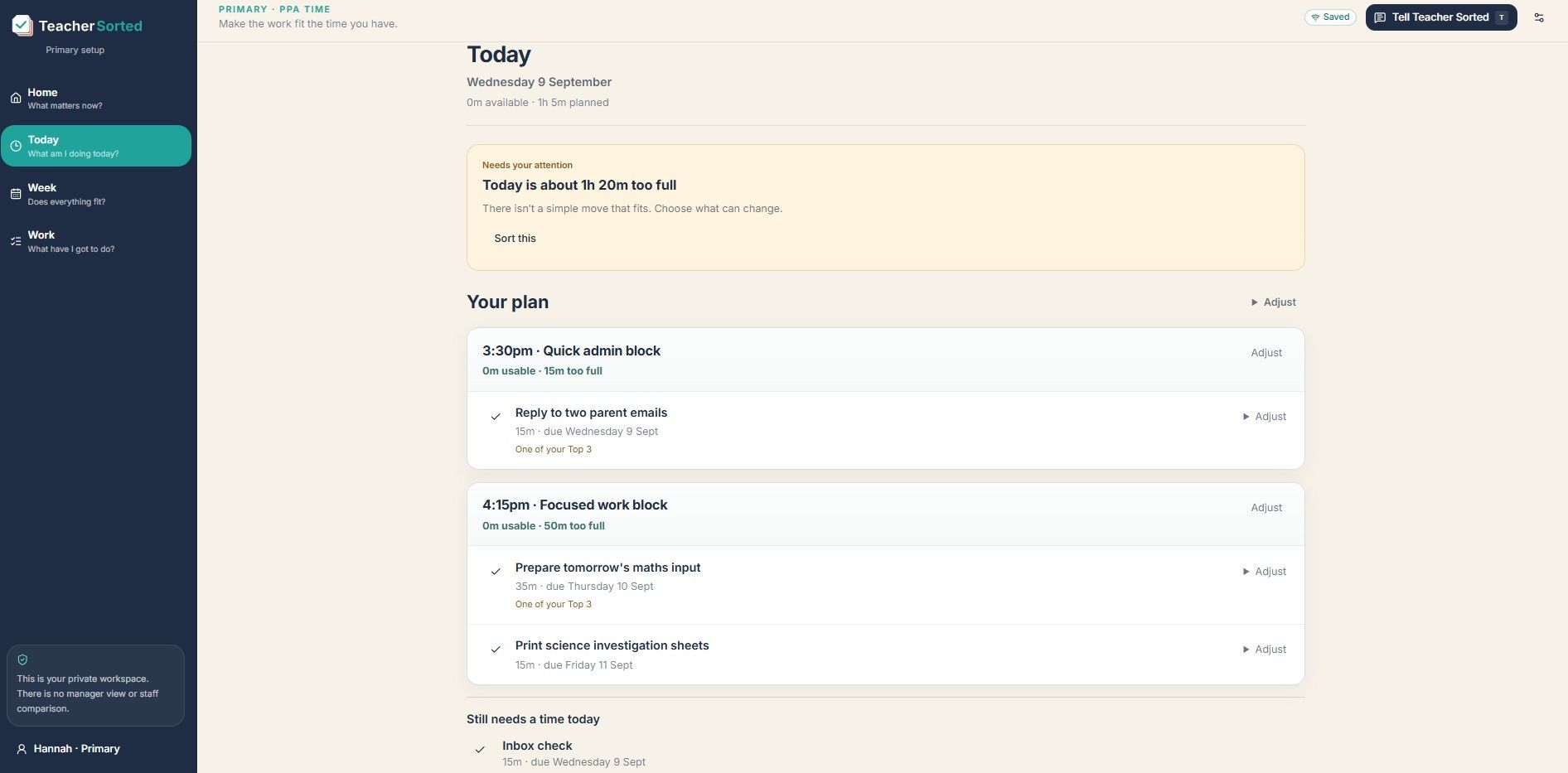
You lose the block to cover. A meeting overruns. A child needs support. A lesson takes longer to prepare than expected. That is part of working in a school, even when it should not be treated as normal for protected time.
When that happens, do not carry the whole original plan into the evening as if nothing has changed.
Look at the work again and decide:
- What must be ready for tomorrow?
- What can move to the next PPA block?
- What can be reduced?
- What can wait until there is a proper stretch of time?
- What does not need doing at all?
For example, if you lost the time planned for marking, you might read enough work to identify tomorrow’s teaching point rather than complete a full written response for every pupil. That may be the sensible choice for the time available.
The decision is still yours, and the professional judgement remains yours. A planner can show that there is not enough room, but it cannot decide what matters most for your class.
Use a PPA planner that shows the real week
A useful PPA planner should show more than a list of jobs.
It should help you see:
- When your PPA actually takes place.
- How long each block lasts.
- Which jobs need focused time.
- What has to be ready next.
- What has already been moved.
- Where the week no longer has enough room.
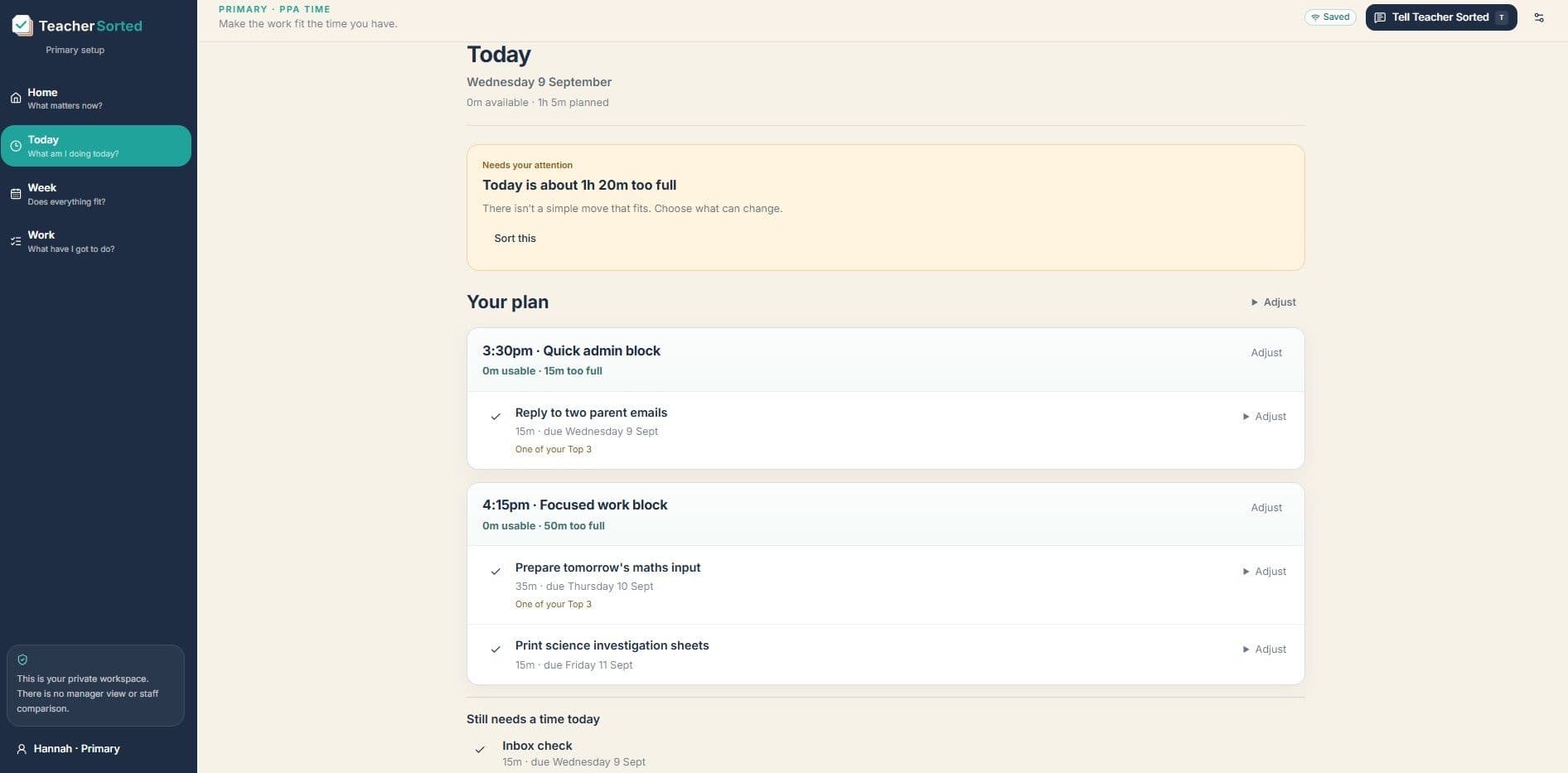
That is the thinking behind Teacher Sorted’s approach to workload planning. You add the work, match it to the time you have and adjust when the school day changes. Nothing is moved without your say-so, and it does not remove the need for your judgement.
The useful outcome is simple: you can see what fits before you start.
A practical plan for your next PPA block
Before your next session, try this:
- Check how long the block actually is.
- Choose one main job.
- Write the first step in plain language.
- Gather what you need before the clock starts.
- Keep short admin jobs separate from deeper planning.
- Set a stopping point.
- Leave yourself a note if you do not finish.
- Rechoose the work if the block changes.
PPA will not make an impossible workload disappear. It cannot create time that is not there.
It can, however, become easier to use when you stop treating it as a chance to catch up with everything and start choosing work that fits the block in front of you.
Make the work fit the time you have. Then decide what deserves the next block.