
Teacher Sorted · 10 September 2026 · 8 min read
Teacher burnout in 2026: what the research actually shows
Learn how current research distinguishes teacher burnout from ordinary tiredness, explores workload’s role and identifies practical ways to manage demands.

By now, most teachers have heard the word burnout so often that it can start to lose its meaning.
A difficult week gets called burnout. So does a late night marking books. So does feeling fed up on a Sunday evening.
Those experiences matter, but they are not all the same thing.
Burnout is usually understood as the result of ongoing workplace stress that has not been managed successfully. It can involve deep exhaustion, growing distance from the job and the feeling that your work is no longer going as well as it should.
That is different from being tired after parents’ evening. Most teachers are tired sometimes. The more serious question is what happens when there is no proper chance to recover, and the work keeps demanding more than the available time can hold.
The latest research suggests that this is where many teachers are now stuck.
What the latest figures show
There is no single, reliable UK figure that says exactly how many teachers are “burnt out” in 2026. Different surveys ask different questions. Some measure stress. Some measure poor mental health. Others ask about workload, sleep or intentions to leave.
That distinction matters. It is better to be precise than to attach one dramatic number to a complicated problem.
The figures are still serious:
- 76% of education staff reported workplace stress in the Teacher Wellbeing Index 2025.
- 77% reported symptoms of poor mental health linked to work.
- 36% were identified as being at risk of probable clinical depression using a recognised wellbeing measure.
- In the NASUWT Wellbeing at Work Survey 2025, 82% of teachers said they had experienced more work-related stress over the previous year.
- 67% said their job had adversely affected their physical health.
- In the Department for Education’s Working Lives of Teachers and Leaders survey, around 57% said their job negatively affected their mental health.
That last figure is sometimes repeated as “57% of teachers are burnt out”. It does not say that. It measures the reported effect of the job on mental health.
The real picture is broader. A large number of teachers are stressed, struggling to switch off and finding that work is affecting their mental and physical health. Those are conditions in which burnout can develop.

Workload is not a side issue
It is tempting to treat burnout as a personal wellbeing problem.
Perhaps you need better boundaries. Perhaps you should meditate, exercise more or organise your time more carefully.
Some of those things may help you cope with a difficult period. They cannot solve a job that regularly contains more work than there are hours to do it.
The NASUWT survey identified workload as the leading cause of work-related stress, ahead of pupil behaviour and poor management. The NFER Teacher Labour Market in England Annual Report 2025 found that 90% of teachers considering leaving teaching cited high workload as a factor.
That is a useful correction to the usual conversation about resilience.
If you have lessons to prepare, books to mark, meetings to attend, safeguarding concerns to record, parents to contact and a timetable that keeps changing, the problem is not always that you have failed to plan well enough.
Sometimes there is simply too much work for the time available.
That does not mean nothing can be done. It means the useful response has to include the work itself, not just your reaction to it.
How to tell tiredness from burnout
There is no quick checklist that can diagnose burnout. If you are concerned about your mental health, speak to your GP or an appropriate professional.
As a general guide, ordinary tiredness tends to improve when you get some proper rest. You may have a hard day, but you can still recover after a quiet evening, a weekend or a break from school.
Burnout usually feels more persistent. You might notice:
- Exhaustion that does not lift after rest.
- Growing cynicism or detachment from pupils, colleagues or the job.
- Difficulty concentrating on tasks you would normally manage.
- A sense that nothing you do is enough.
- More frequent physical symptoms such as poor sleep, headaches or tension.
- Feeling unable to stop thinking about work, even when you are at home.
- Losing confidence in your ability to do the job well.
These signs do not mean you are weak or unsuited to teaching. They are signals that the current pattern is costing too much.
The NASUWT survey found that workload was linked to high levels of anxiety and loss of sleep. The NEU’s State of Education report also found that many teachers regularly struggle to switch off from work at home.
Rest matters. So does reducing the amount of work that follows you home.

What can help with teacher stress management?
There is no five-step routine that will make an overloaded school day fit neatly into place. But there are practical decisions that can reduce the amount of work competing for your attention.
1. Name the work that is actually there
When your workload stays in your head, everything can feel equally urgent.
Write down the tasks that are taking up space. Include the small ones:
- Reply to parent email.
- Prepare Tuesday’s science lesson.
- Mark Year 6 books.
- Complete assessment notes.
- Find resources for the meeting.
- Chase permission slips.
You do not need to build a complicated system. The first benefit is seeing the size and shape of the work rather than carrying it as a vague sense of pressure.
2. Match tasks to the time you really have
Look at the time available today, not the time you wish you had.
If you have 35 minutes of PPA time, do not plan 90 minutes of work into it. Choose what fits. A short task may be more realistic than starting a large piece of planning that you cannot finish.
This is also where schools and leaders have a responsibility. A teacher cannot organise their way out of a timetable that leaves no time for essential work.
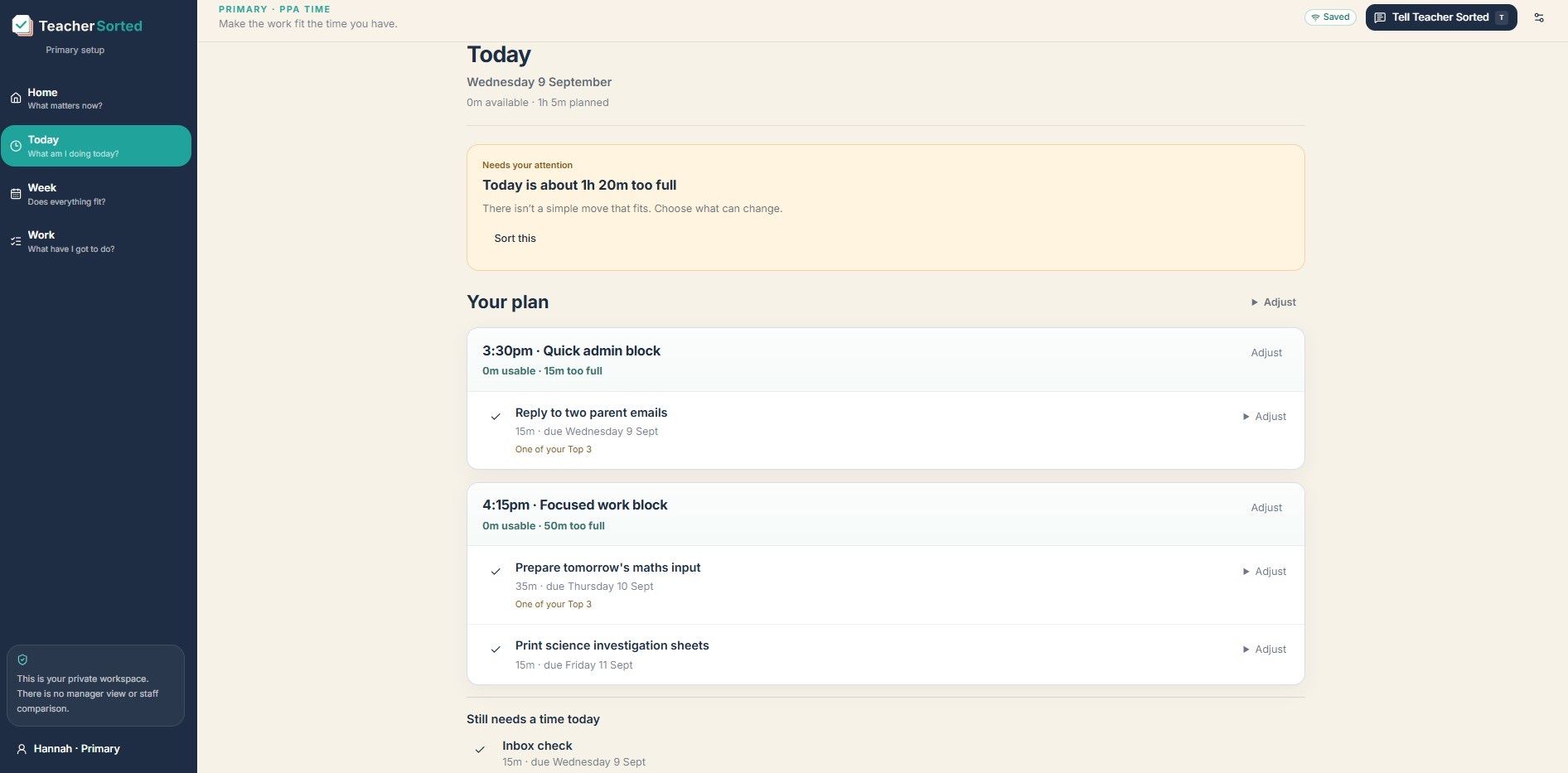
3. Decide what can move
A task can be important without needing to happen today.
When the school day changes, look again at the plan. Move the task that can wait. Keep the deadline that matters. Let go of the assumption that every item must remain fixed just because it was written down in the morning.
A plan that changes is not a failed plan. It is a more honest description of the day.
4. Leave a first step for tomorrow
Stopping is easier when you know where to begin again.
Instead of leaving “plan history lesson” on your list, leave a note such as:
Check the source cards and choose two examples.
That small note reduces the need to reconstruct the whole task when you return. You are not promising to finish everything. You are making the next decision easier.
What schools need to change
Individual teacher stress management has a place, but it cannot carry the whole burden.
Schools need to look at the amount of work being set, the time provided for it and the expectations around marking, planning, meetings and communication.
The NASUWT survey found that 65% of teachers said their school lacked measures to monitor and manage stress and burnout. It also found that many teachers did not have clear guidance on switching off or responding to emails outside working hours.
A wellbeing policy cannot compensate for an impossible workload. Telling people to protect their work-life balance while adding another meeting to an already full week will not achieve much.
Useful questions for a department, year team or leadership group include:
- Which tasks must happen this week?
- Which tasks are useful but can wait?
- Where has protected planning time been lost?
- What work is being duplicated?
- Which deadlines are set by law or genuine need?
- Which deadlines have simply become habits?
- What happens when the timetable changes?
Those questions move the conversation away from whether teachers are coping well enough. They put the focus back on the work and the time available to do it.
Teacher burnout is not a personal failure
The research does not show a profession that needs to become more resilient so it can absorb unlimited work.
It shows teachers working in conditions where demand regularly exceeds time. It shows the effects in stress, poor sleep, reduced wellbeing, physical health problems and decisions to leave.
You can take your wellbeing seriously without pretending that workload is only an individual problem. Speak to someone if your mental or physical health is being affected. Use the support available through your school, union, GP or services such as Education Support.
Then look at the work itself.
What has to happen? What can wait? What fits today? What needs to be raised with someone else?
Teacher Sorted is built around that practical question: make the work fit the time you have. It does not decide what matters for you, and it does not make a difficult workload disappear. It can help you see what fits, adjust when the day changes and leave yourself a clear place to return to.
The important point is simple: burnout should not be treated as proof that a teacher has not tried hard enough. When there is more work than time, the answer has to include an honest look at both.