
Teacher Sorted · 10 September 2026 · 8 min read
Stop planning the perfect week. Plan the week you actually have.
Learn how to plan around genuine available time, prioritise essential work, estimate tasks honestly and adjust your week when school life changes.

There is a particular kind of optimism that appears on a Sunday evening.
You look at the week ahead and decide that this will be the week when everything fits. You will use your PPA properly, mark the books, plan the lessons, reply to the emails and still leave at a sensible time on Thursday because you have an appointment.
Then Monday happens.
A meeting runs over. A child needs a conversation. Your planned PPA becomes cover. Somebody asks for a resource by Wednesday. The maths lesson takes longer than expected. By Tuesday afternoon, the plan is already behind.
This is not usually because you planned badly. It is because you planned a week that did not exist.
Look at the time before you list the work
Most weekly planning starts with the work.
You write down:
- Plan next week’s lessons
- Mark Year 5 books
- Prepare the assembly
- Reply to parents
- Update assessment information
- Sort the science resources
- Complete the training task
Then you try to fit all of it into the week.
That order creates a problem. The list grows easily, but the available time does not.
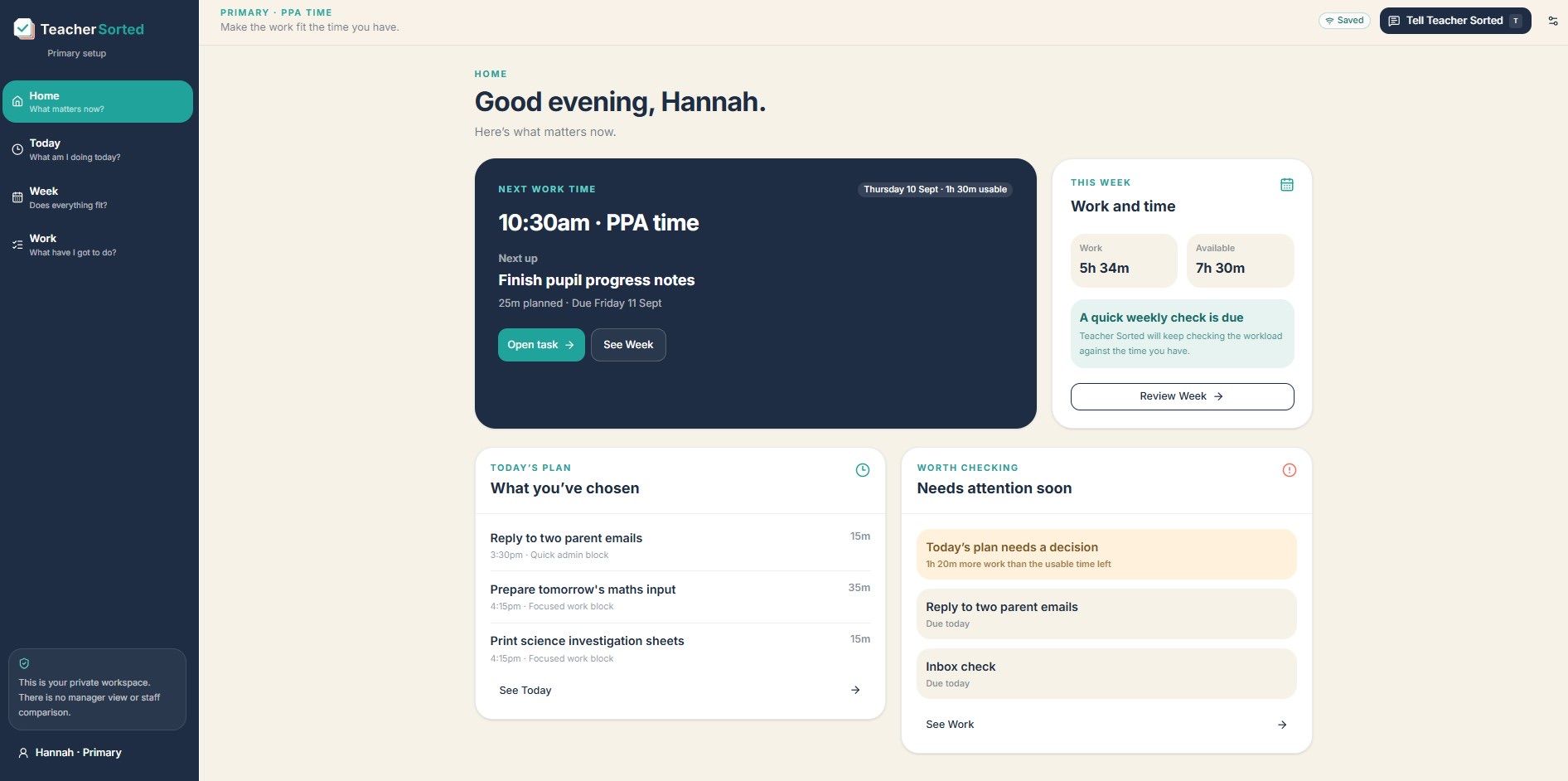
A more realistic approach starts with the time that is actually yours.
Look first at:
- Your PPA slots
- Preparation periods
- Time before or after school that you have chosen to use
- Existing meetings
- Duties and supervision
- Appointments or other commitments
- The points in the week when you know you will be too tired for demanding work
You do not need to account for every minute. You do need an honest picture of the useful time available.
If you have two hours of PPA, one after-school meeting and a dentist appointment on Thursday, that is the shape of the week. Planning as though you have four clear afternoons will not make those afternoons appear.
PPA also needs protecting. The NEU’s guidance on PPA time sets out the position for teachers in England, including the fact that PPA should not be used for meetings, cover or other duties. In practice, schools and timetables vary, but your plan still needs to reflect the time you will genuinely be able to use.
Once you can see the time, you can decide what belongs in it.
Add the work that matters this week
Not every job needs to be completed in the next five days.
That can be difficult to accept when the work is all sitting in front of you. A task without a place on the calendar can feel as though it is being ignored. It is not being ignored. It is simply not being claimed by this particular week.
Start with work that has a real reason to happen now.
For example:
- Prepare tomorrow’s lesson
- Mark books needed for Friday’s meeting
- Send the reply promised to a parent
- Finish the resources for Thursday’s practical
- Complete the report needed for the moderation session
Then add work that would be useful, but can move if the week fills up.
This might include:
- Tidying a shared folder
- Improving a lesson resource
- Updating a display
- Reviewing a scheme of work
- Starting a task that has no immediate deadline
The distinction matters. If everything is treated as equally urgent, your plan has no way to tell you what to protect when something changes.
You may still choose to do the display before the reports. That is your decision. The point is to make the decision while looking at the time you have, rather than discovering on Friday evening that the plan contained eight hours of work and three hours in which to do it.
Give tasks an honest amount of time
Planning also goes wrong when tasks are added without a rough idea of how long they will take.
“Mark books” could mean 20 minutes for a quick check, or three hours for a detailed piece of feedback across a full set. “Plan maths” might mean choosing a task from a familiar sequence, or creating a new lesson and all its resources from scratch.
You do not need perfect estimates. A useful approximation is enough.
Try:
- Mark Year 6 writing: 60 minutes
- Reply to two parent emails: 15 minutes
- Prepare tomorrow’s maths input: 35 minutes
- Print science investigation sheets: 10 minutes
- Review assessment notes: 25 minutes
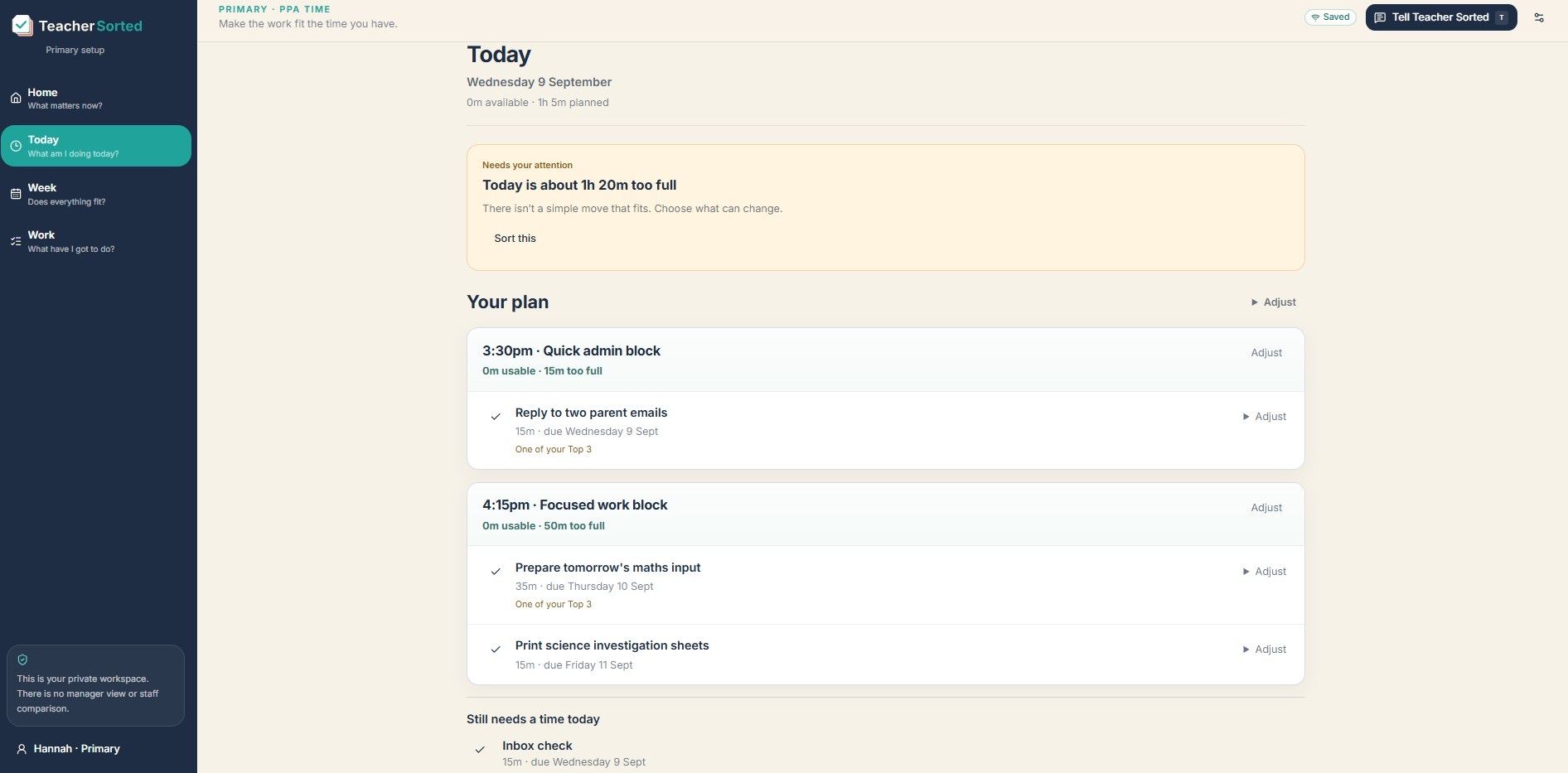
The estimate gives the task somewhere to go. It also makes the gap visible when there is not enough room.
That visibility is useful. You can then choose whether to:
- Reduce the task
- Reuse something already prepared
- Move it to another week
- Ask for help
- Discuss the deadline
- Decide that it is not needed after all
This is a better position than simply adding another task to an already full afternoon and hoping you will somehow become quicker.
Leave some room for the week to misbehave
A school week rarely uses every available minute neatly.
Even protected time can be affected by a safeguarding issue, a pupil conversation or a job that cannot wait. The answer is not to fill every slot in advance. A plan with no spare room is already too full.
If you have three hours of useful non-teaching time, do not automatically schedule three hours of work. Some tasks take longer than expected. You may need to find a resource, speak to a colleague or deal with something that appeared at the classroom door.
A little space gives you somewhere to put the unexpected.
This is especially important for teachers who work in short blocks. A 20-minute gap between lessons may be useful for printing, sending one email or checking a set of books. It may not be useful for a task that needs concentration and a clear run.
Match the work to the shape of the time.
Use short blocks for:
- Printing and copying
- Sending a straightforward email
- Updating a list
- Finding a resource
- Preparing materials for tomorrow
Keep longer blocks for:
- Detailed marking
- Lesson planning
- Assessment
- Writing reports
- Work that needs careful thought
The aim is not to fill every gap. It is to stop expecting every kind of work to fit into every kind of time.
Adjust when the week changes
At some point, the plan will stop fitting.
That is not a sign that the plan has failed. It is information about the week you are now dealing with.
Perhaps your Wednesday PPA was lost to cover. Perhaps the meeting on Tuesday lasted 45 minutes longer than expected. Perhaps you spent Thursday afternoon supporting a child who was having a difficult day.
Look at what changed, then make one clear decision.
You might protect:
- The marking needed for tomorrow’s lesson
- The parent response with a promised deadline
- The preparation needed for a practical activity
You might move:
- A display update
- A resource tidy-up
- A task with no immediate consequence
- Work that can usefully wait until next week
You might reduce:
- The amount of detail in a resource
- The number of books receiving extended comments
- The time spent making something look finished when it is already fit for purpose
You might need to discuss:
- A deadline that no longer fits
- A task that has become larger than expected
- A piece of work that needs another person’s input
The important part is to make the adjustment deliberately. Otherwise, the plan continues to suggest that everything will fit, even after the time has disappeared.
A teacher planning software tool can help with this by showing the work against the time available. That is useful when it remains a prompt for a decision, rather than another system telling you what to do.
Use tools that show the week you have
Many teacher organisation tools begin with a list of tasks. That is helpful for getting work out of your head, but it does not answer the harder question: where will the work go?
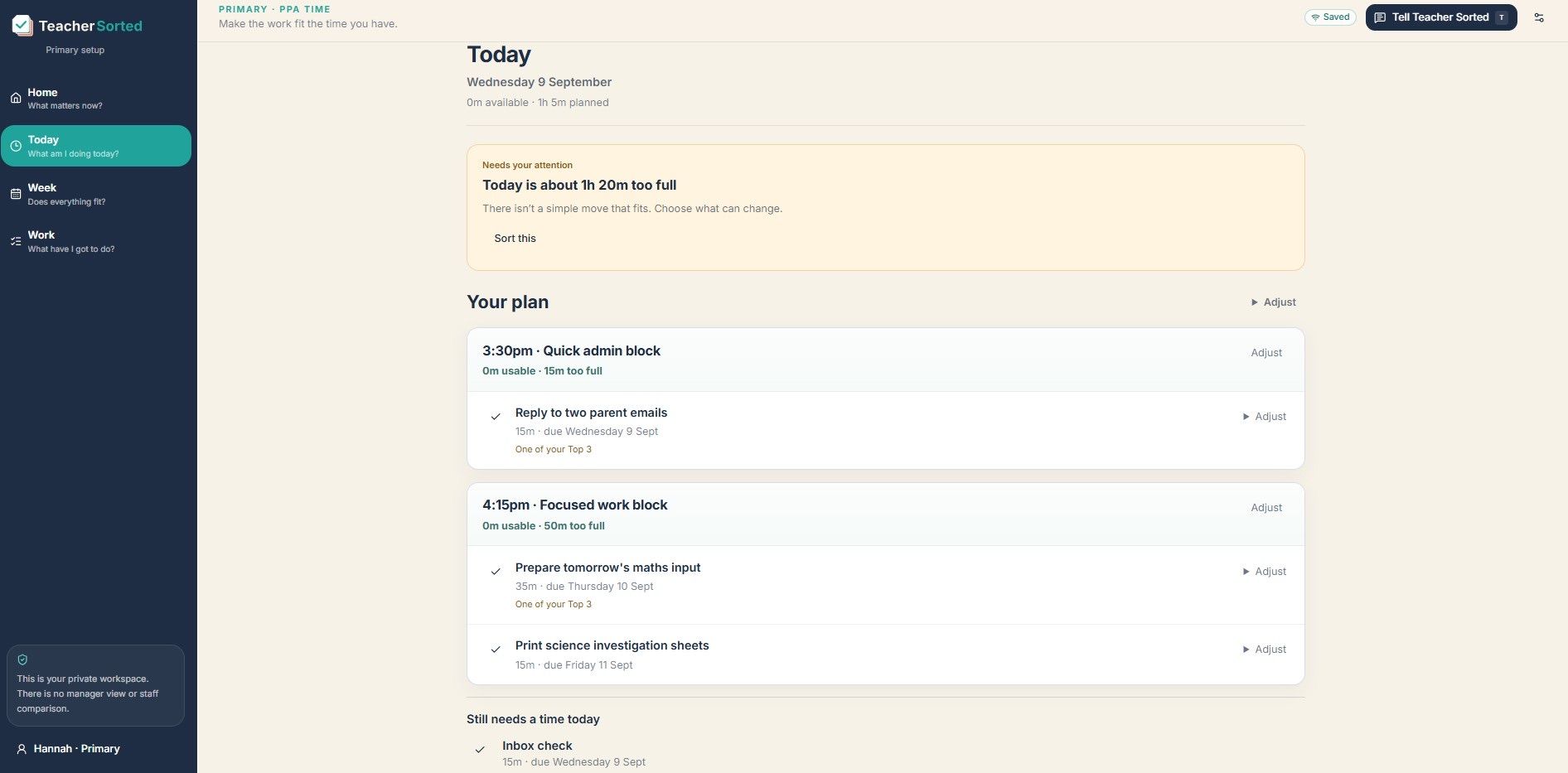
A realistic planning tool needs to show both sides:
- The work that needs doing
- The time available to do it
Teacher Sorted is built around that comparison. You can add the work in ordinary language, add your PPA or other non-teaching time, and see whether the week fits. If something changes, you can record it and decide what to move, reduce, postpone or discuss.
Nothing moves without your say-so. The wider list can stay there without pretending that every task belongs in this week.
You can see how Teacher Sorted works if that approach would be useful. You can also read the frequently asked questions before deciding whether it is the right fit for you.
The tool is only useful if it reflects the way your week actually works. It cannot create more PPA, shorten a meeting or make a difficult conversation disappear. It can help you see the gap before you spend another evening trying to close it.
Plan the week you can return to
A good weekly plan should still make sense after Monday has happened.
It should tell you what matters next. It should show what fits and what does not. When something changes, it should give you a place to make a decision rather than leaving you to start again from a blank page.
You do not need to complete every task to have planned well. You need to know what the available time can hold, what needs protecting and what can wait.
The perfect week is not very useful if it disappears as soon as school gets busy.
Plan the week you actually have, and leave yourself a clear place to begin again.